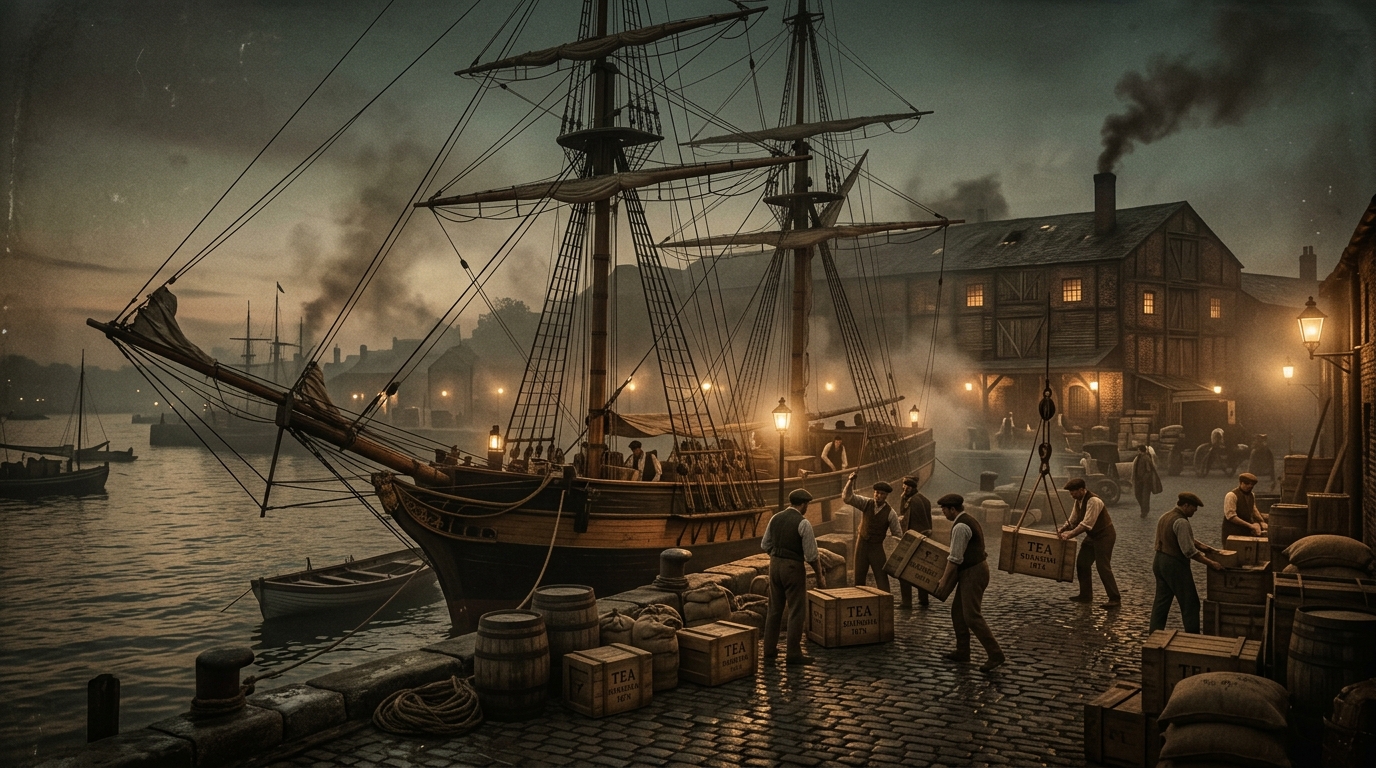
The Boston Tea Party: Politics Brewed in a Teacup
On a December night in 1773, men—some dressed as Mohawk warriors—threw 92,000 pounds of tea into Boston Harbor. The target was a tax, a monopoly, and the authority behind both.
Sameera
· 6 min read

On the night of December 16, 1773, around a hundred members of the Sons of Liberty — some, but not all, dressed as Mohawk warriors — boarded three British ships at Griffin's Wharf in Boston Harbor. Over the next three hours they smashed open 342 wooden chests and emptied 92,000 pounds of East India Company tea into the water. In today's money, the cargo was worth roughly $1.7 million.
It wasn't only about taxes — but tax was central. The Tea Act of 1773 actually lowered the legal price of East India Company tea in the colonies, but it kept the Townshend duty on tea that colonists had been disputing since 1767. Paying for cheaper tea meant conceding Parliament's right to tax unrepresented colonists — which is precisely what the protesters refused to do. The Company, struggling financially, had also been granted the right to ship directly to America, undercutting Dutch smugglers and unloading its surplus inventory.
It was about monopoly and merchants. The protest came from American merchants — the Hancocks, the Cushings, and other Boston merchants — who were about to be put out of business by a multinational dumping product into their market with state backing. It was, in part, a protest by local sellers against state-sponsored corporate dumping — and at the same time the sharpest expression yet of a constitutional argument, 'no taxation without representation', that had been building since the 1760s. The two grievances reinforced each other.
The British response was disproportionate. The Coercive Acts (or, as Americans call them, the Intolerable Acts) closed the port of Boston, severely curtailed self-government in Massachusetts, and authorized quartering of British troops in unoccupied buildings when barracks were insufficient. Within eighteen months, the colonies were at war.
A small footnote. The tea itself was good Chinese stock — mostly Bohea, a black tea from Fujian's Wuyi mountains. By morning, some of it had washed back up onshore. Small amounts were salvaged and quietly sold soon after.
Follow The Tea List