Tea and Espionage: The Spy Who Stole China's Tea Secrets
In 1848, a Scottish botanist disguised himself in Chinese dress, travelled into Fujian's tea country closed to foreigners, and brought out plants, seeds and tea-makers for British India. The story, as he told it.
Sameera
· 8 min read
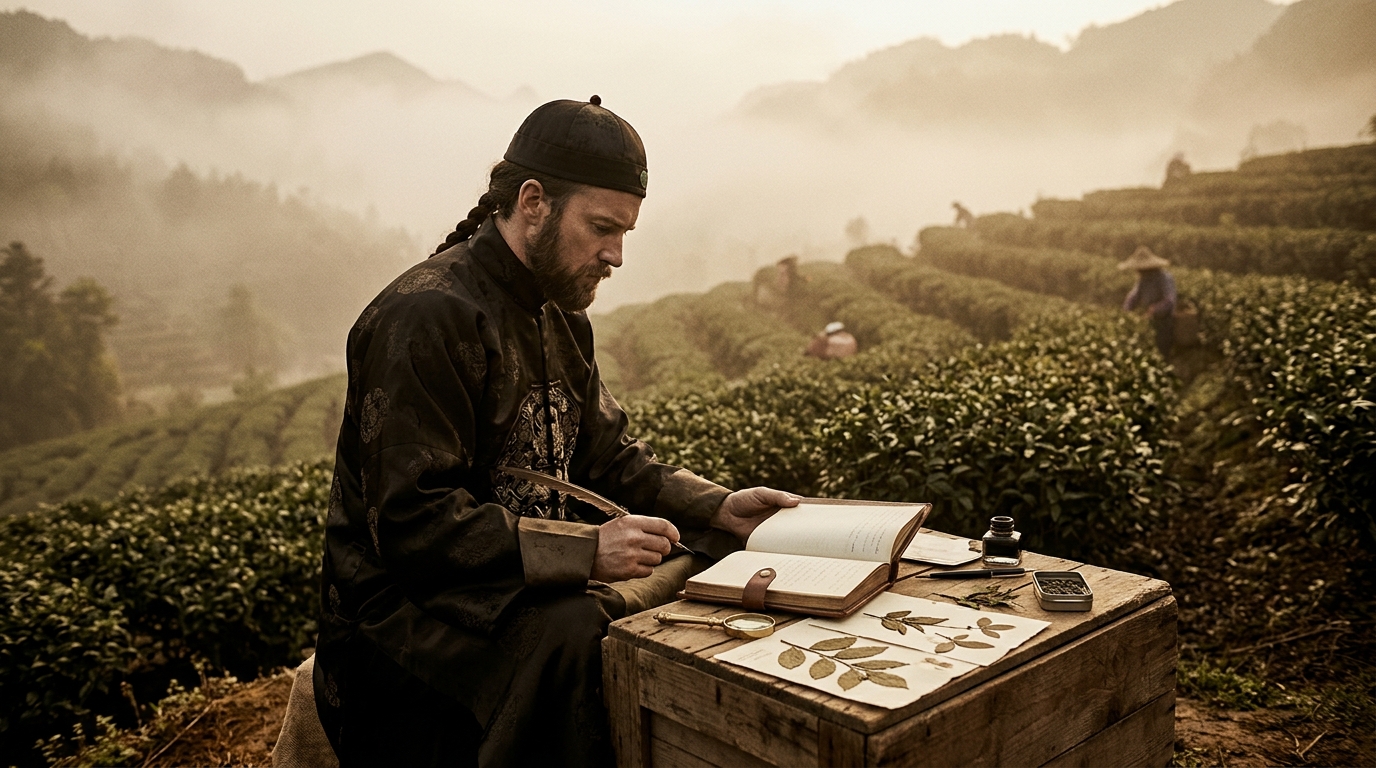
In 1848, a Scottish botanist named Robert Fortune shaved his head, had a false queue attached, dressed in Chinese clothes and travelled into the tea-producing interior of Zhejiang, Anhui and Fujian — districts closed to foreigners under the treaties of the day. He described all this himself in A Journey to the Tea Countries of China (1852). Over the following three years he collected seeds, plants and manufacturing knowledge for the British East India Company's plantations in India, in what is often described as one of the largest acts of corporate espionage in history.
The mission. Chinese tea was essential to British life and finance, and the Company wanted to grow it in India rather than keep paying China for it. The Company already had tea in Assam—the native Assam plant had been identified in the 1820s–30s and the first Assam tea was auctioned in London in 1839—but it wanted China's prized varieties and, above all, China's processing expertise. Fortune, a 36-year-old plant collector with experience in southern China, was engaged for the job; the East India Company's records put his salary at £500 a year, a substantial sum for a gardener of his background.
The disguise. Fortune travelled with a Chinese servant, who taught him how to walk, eat, and speak in the manner of a regional Chinese official. He could not pass close inspection — his face was wrong, his Mandarin was passable but limited — but at a distance, in a sedan chair, with the right clothing and entourage, he was unremarkable.
What he took. Fortune's own account and later histories (notably Sarah Rose's For All the Tea in China, 2010) describe tens of thousands of plants and seedlings shipped to the Himalayan foothills, most of the early consignments dying in transit before he hit on sowing seed in Wardian cases, along with a small team of Chinese tea-makers he recruited to teach processing. The precise numbers vary between accounts, so treat any single figure as approximate.
The consequence. Fortune's plants and tea-makers contributed to the Darjeeling industry in particular; Assam's industry, already under way, developed largely from the native Assam plant. Within forty years British India and Ceylon dominated British imports, though China remained a major global producer and exporter and there was never a true British monopoly. It would be wrong to credit one man with starting Indian tea—he accelerated a project that was already in motion.
Was it espionage? Almost certainly yes, by any modern definition. Fortune was working for a private company under government protection, in violation of the host country's explicit laws, with the goal of stealing trade secrets worth billions in modern terms. He published a polite memoir about his travels in 1852 — A Journey to the Tea Countries of China — which carefully omitted the most damning details. The full picture became clearer when historians later compared his book to East India Company shipping records.
Fortune died in 1880, wealthy and respected, in a comfortable London suburb. The empire he helped build by stealing one plant from one country reshaped the global drink habits of half the world.
Follow The Tea List