Best Specialty Tea Cafés in Melbourne: A Suburb-by-Suburb Guide
Melbourne's tea culture has quietly evolved beyond the teapot-and-scone formula. A verified guide to the city's dedicated tea venues — with addresses and hours checked against each venue's own website.
Sameera
· 4 min read
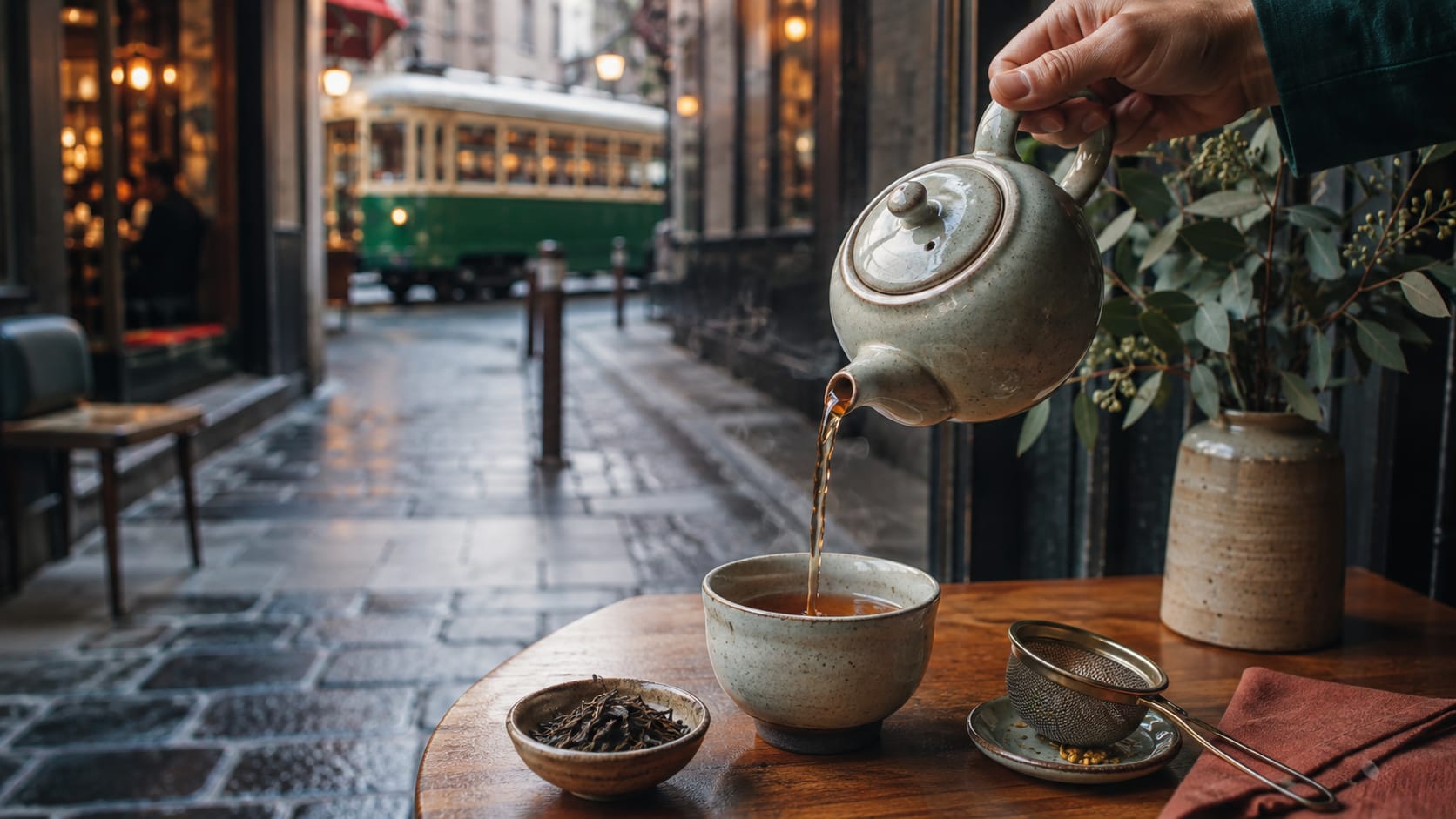
On a drizzly Thursday afternoon in Melbourne, a woman in her seventies sits at a low timber table, cupping a porcelain gaiwan between her palms. She's learning to brew Tie Guan Yin the traditional way — short, repeated steeps that coax different notes from the same leaves. Rain taps against the window. This is not the Melbourne tea scene of ten years ago, when chai lattes and English Breakfast ruled the menu boards. This is tea as a quiet rebellion against extraction culture, where fifteen minutes of focused attention yields something money alone cannot buy.
Editor's note (October 2026): this guide was rebuilt to include only venues whose location, hours and offering we could confirm from the venue's own website. Several previously listed cafés have been removed—not because they have closed, but because we could not verify the details we had published about them. Addresses and hours below were checked in October 2026; confirm with the venue before travelling.
Why Melbourne's tea culture is having a moment
Melbourne has always been Australia's coffee stronghold, but over the past decade a small set of tea-focused venues has emerged alongside the heritage tea rooms, several run by proprietors with roots in Taiwan, Japan or China's tea-growing provinces. Unlike spaces that trade on nostalgia, these prioritise origin, processing and brewing technique. The clientele skews younger than you might expect — Melburnians raised on specialty coffee applying the same discerning palate to Camellia sinensis. In winter (June through August, when Melbourne's weather truly commits to grey), these venues become sanctuaries for the deliberately slow.
Oriental Teahouse — Melbourne CBD, South Yarra and Brunswick
Oriental Teahouse pairs Chinese tea with yum cha across three venues. The CBD teahouse is at 378 Little Collins Street and, according to the venue's own listing, opens Monday to Thursday 11:30am–3pm and 5:30–9pm, Friday 11:30am–3pm and 5:30–10pm, and Saturday 12–3pm and 5:30–10pm; it is closed on Sundays. The original South Yarra teahouse at 455 Chapel Street keeps longer hours seven days (from noon on weekdays and 11:30am on weekends), and a smaller Brunswick teahouse at 202 Albion Street trades Wednesday to Saturday evenings. The format — a long tea list alongside dumplings, turnip cakes and congee — makes it one of the few places in the city where a pot of Chinese tea is the centre of a meal rather than an afterthought. Menus, prices and current tea selections change; check the venue's website before you go. Booking is sensible on Friday and Saturday evenings.
Tea Drop Brew Bar — South Melbourne Market
Tea Drop, a Melbourne-founded tea brand, runs its flagship Brew Bar at Shop 34 inside South Melbourne Market, on the corner of Cecil and Coventry Streets. The company describes it as a destination for tea discovery: brews made to order by its tea makers, seasonal sparkling tea on tap, and the retail range of blends and teaware alongside. Opening hours follow the market's trading days — at the time of checking, Wednesday 8am–4pm, Friday 8am–5pm, and Saturday and Sunday 8am–4pm, closed Monday, Tuesday and Thursday. It's a market stall rather than a sit-down tea room, so treat it as a place to taste, buy and ask questions rather than settle in for an hour with a gaiwan.
Where the rest of the scene is
Melbourne has more serious tea than two venues, and this guide will grow as we verify them. Specialist loose-leaf retailers in the inner north, matcha-focused cafés in the bayside suburbs, and coffee bars with thoughtful short tea lists all exist — but we will only list a venue once we can confirm from its own website or a documented visit what it actually serves, when it opens and what it charges. If you run a tea venue in Melbourne and would like to be considered, send us your current menu and hours.
What makes a tea café worth seeking out
The best tea cafés share certain qualities beyond good sourcing. They pay attention to water temperature, in the same way specialty coffee treats extraction — most Japanese and Chinese greens at roughly 70–80°C, oolongs around 85–95°C, black teas at or near the boil, always as starting points rather than laws. They use filtered water and time their steeps rather than guessing. They offer proper teaware — ceramic or glass that doesn't retain flavours, in sizes suited to solo or shared service. They are honest about terms like "ceremonial grade", which is a seller's description with no standardised definition in Japan rather than a certification. Most importantly, they create environments where spending forty minutes with one pot of tea feels natural rather than pressured. In a city that turned coffee into competitive sport, these venues are proving that tea's slower rhythms can coexist with urban intensity.
The gaiwan sits empty now, its porcelain cool against wood, leaves unfurled and spent after seven patient steeps.
Follow The Tea List