The Most Expensive Tea in the World — and Who Buys It
A handful of old tea bushes on a Chinese cliff. A legend several centuries old. Two auctions, in 2002 and 2005, that briefly broke the rules of commodity pricing.
Sameera
· 5 min read
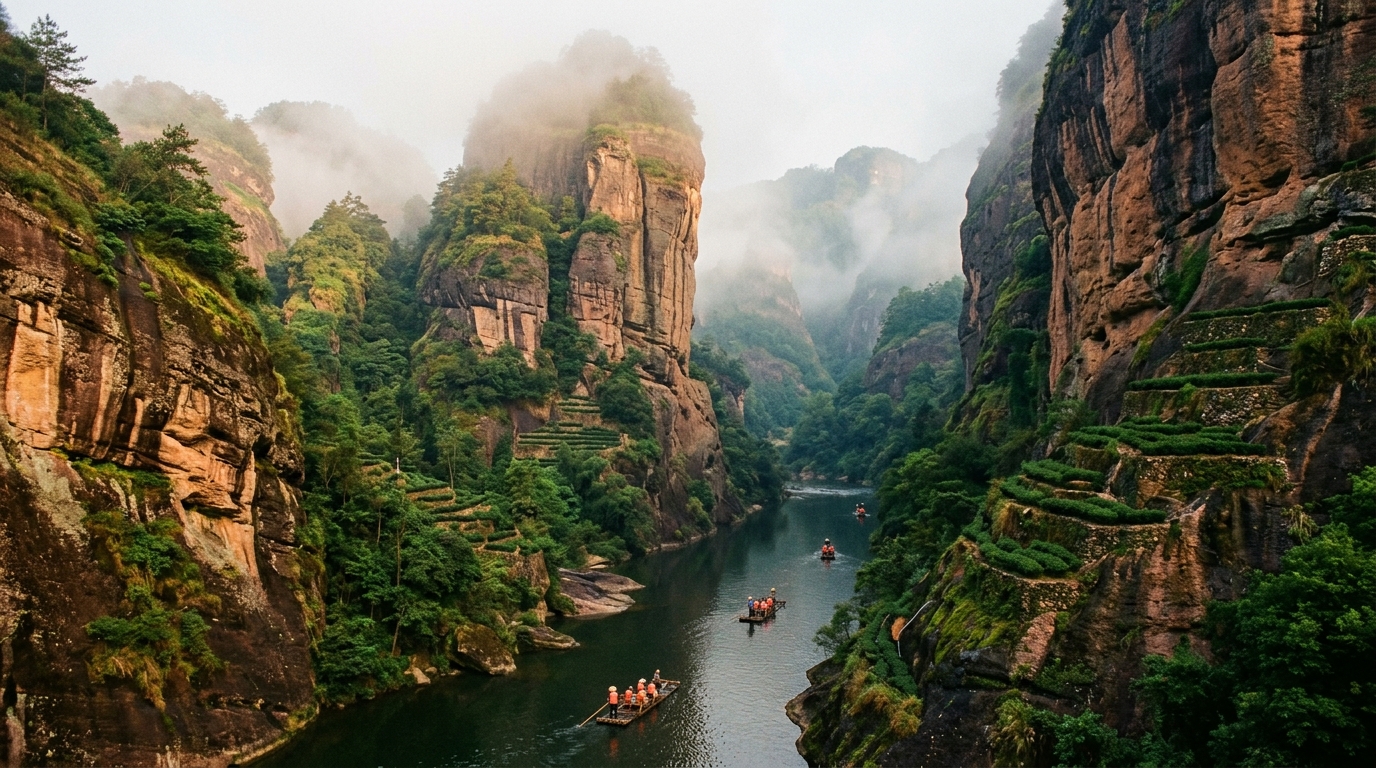
On a sheer rock face at Jiulongke in the Wuyi mountains of northern Fujian, a small group of old Da Hong Pao mother bushes — most accounts count six — grow out of fissures in the stone. Local tradition puts their age at several centuries, though that is tradition rather than measurement. They have not been harvested since 2006, so they produce no tea for sale; their fame rests on two auction lots sold two decades ago.
The legend. In the late Ming dynasty, a young scholar travelling to Beijing for the imperial examinations fell desperately ill in Wuyi. Local monks brewed him a tea from the cliff trees; he recovered, passed his exams, and returned years later as a court official. He climbed back to the cliff and draped his red ceremonial robes around the bushes in gratitude. The tea has been called Da Hong Pao — Big Red Robe — ever since.
The auctions. In 2002, a 20-gram lot of leaf attributed to the mother bushes sold at auction in Guangzhou for 180,000 yuan (9,000 yuan per gram). In 2005, another 20-gram lot sold in Wuyishan for 208,000 yuan (10,400 yuan per gram). We leave the figures in yuan rather than converting them: a conversion needs a dated exchange rate, and a per-kilogram extrapolation from a 20-gram lot is a mathematical flourish, not a market price. Whether these were the most expensive tea sales ever by weight is not something we can establish; they are certainly among the most famous.
The protected mother bushes. The bushes were last picked in 2005 and 2006, after which the Wuyishan authorities stopped all harvesting and placed them under protection. Most Da Hong Pao on the market today comes from clonal cultivars (e.g., Qi Dan, Bei Dou) propagated in Wuyi, not from the mother trees themselves.
Who buys it. The original auction lots went to wealthy Chinese collectors and to a Singaporean tea merchant. Commercial Da Hong Pao — the clonal teas — is sold mostly to serious Chinese tea collectors, gift markets within China and Hong Kong, and a growing number of Western specialty buyers, at prices that vary widely with maker, roast and harvest. Since the mother bushes have not been harvested since 2006, any tea sold today as 'mother-tree Da Hong Pao' cannot be current harvest; treat such labels as marketing shorthand for the clonal lineage unless a seller can document otherwise.
Is it worth the price? A good clonal Da Hong Pao is genuinely extraordinary tea — dark fruit, mineral, a long roasted finish — and it need not cost a fortune. The original mother-bush leaves were probably similar in flavour. What those auction buyers were paying for was history. Not flavour.
Follow The Tea List