A Beginner's Guide to Brewing the Perfect Matcha
From bamboo whisks to water temperature — everything you need to know to make café-quality matcha at home.
Sameera
· 6 min read
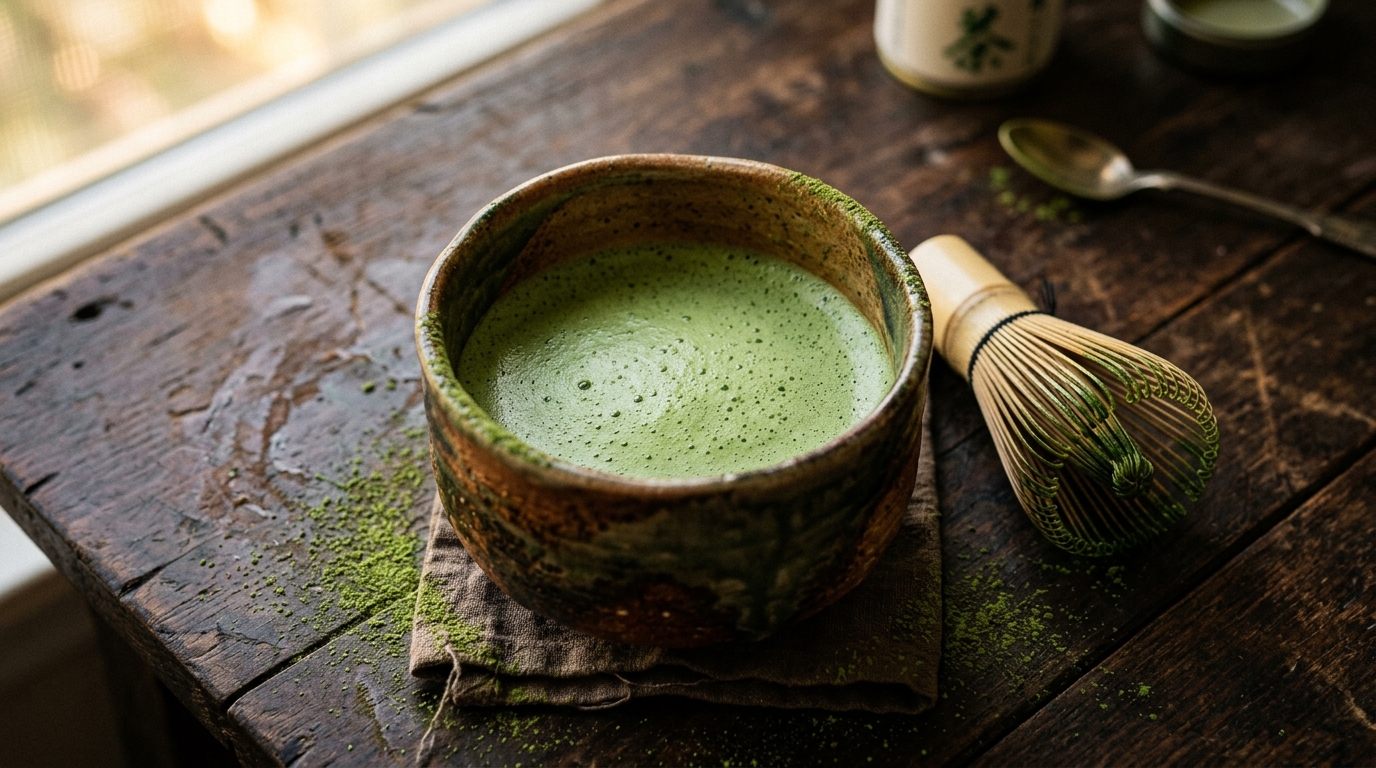
There's a quiet ritual in preparing matcha that has survived nine centuries and now fits neatly onto a weekday morning.
The five-step method.
1. Sift two grams of a matcha intended for drinking straight into a warmed bowl using a fine mesh sieve. Sifting prevents lumps. (Two grams is roughly one teaspoon by volume, or about two level chashaku scoops.)
2. Heat water to about 75°C — not boiling — as a starting point; many drinkers go a little hotter or cooler to taste. Use a thermometer or a variable-temperature kettle. Without one, pour the boiled water between two cups a few times, which cools it by several degrees per pour; it's an approximation, so taste and adjust rather than trusting a fixed number of seconds.
3. Pour 70ml of water over the matcha.
4. Whisk in a gentle W-motion with a bamboo chasen until a fine foam blooms on the surface. About 15 seconds of brisk whisking.
5. Drink immediately. Matcha doesn't keep — even five minutes after preparation, the foam collapses and the liquid stratifies.
What you'll need. A wide ceramic bowl (a chawan; about 12cm wide is ideal), a bamboo whisk, a fine sieve, a small scoop. The whole kit is a modest outlay from a specialty Japanese tea shop, and a chasen typically lasts months to a couple of years with gentle use if you rinse it in cold water after each use.
A few honest truths. "Ceremonial grade" and "culinary grade" are sellers' descriptors, not standardised Japanese grades or certifications — long-established Kyoto house Ippodo, for one, doesn't use the term "ceremonial" because it originated in overseas marketing. All genuine matcha is made from shade-grown tencha; price differences reflect cultivar, harvest, leaf selection and milling rather than a tencha-versus-sencha divide. The practical question is whether a particular matcha is pleasant to drink straight (usually smoother, sweeter, more umami) or better suited to lattes and baking (usually more robust and bitter), which a good supplier will tell you. Temperature matters more than whisking speed. And a wide bowl isn't optional — it's the geometry the whisk requires.
The first sip should taste of spring grass and ocean, not bitterness. If it's bitter, the water may be too hot or the matcha old — but cultivar, processing, dose and quality all shape bitterness too, so a bitter cup isn't automatically a brewing error. If it's flat, your matcha is probably stale. Keep it airtight and away from heat, light, moisture and odours, use it within a few weeks of opening, and follow the supplier's storage directions; if you refrigerate a sealed tin, let it come to room temperature before opening so condensation doesn't form on the powder.
Start here. Slowly.
Follow The Tea List