Curious Tea Stories

Best Specialty Tea Cafés in Melbourne: A Suburb-by-Suburb Guide

Melbourne's tea culture has quietly evolved beyond the teapot-and-scone formula. These connoisseur-approved cafés offer ceremonial-grade matcha, rare oolongs, and gongfu service across the city's most unexpected corners.

Sameera

August 12, 2026 · 9 min read

Best Specialty Tea Cafés in Melbourne: A Suburb-by-Suburb Guide

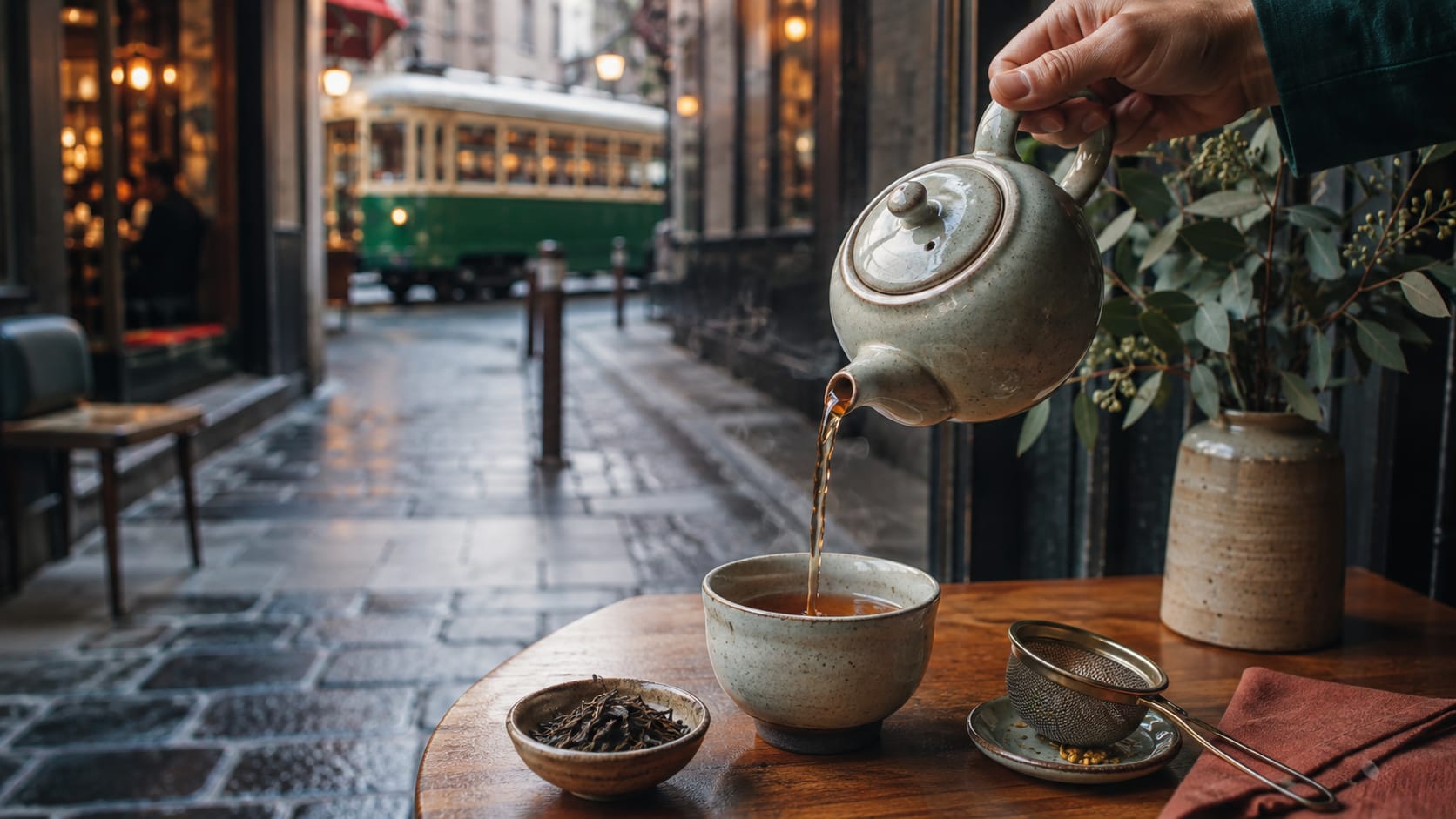
On a drizzly Thursday afternoon in Fitzroy, a woman in her seventies sits at a low timber table, cupping a porcelain gaiwan between her palms. She's learning to brew Tie Guan Yin the traditional way — short, repeated steeps that coax different notes from the same leaves. The barista has dimmed the overhead lights. Rain taps against the window. This is not the Melbourne tea scene of ten years ago, when chai lattes and English Breakfast ruled the menu boards. This is tea as a quiet rebellion against extraction culture, where fifteen minutes of focused attention yields something money alone cannot buy.

**Why Melbourne's tea culture is having a moment**

Melbourne has always been Australia's coffee stronghold, but something shifted around 2018. A critical mass of tea-focused venues opened within eighteen months of each other, many run by proprietors who'd spent time in Taiwan, Japan, or China's tea-growing provinces. Unlike the heritage tea rooms that trade on nostalgia, these new spaces prioritise terroir, oxidation levels, and brewing technique. They source single-estate teas, offer comparative tastings, and stock ceramics you won't find at T2. The clientele skews younger than expected — Gen Z and millennial Melburnians raised on specialty coffee are now applying the same discerning palate to Camellia sinensis. In winter (June through August, when Melbourne's weather truly commits to grey), these venues become sanctuaries for the deliberately slow.

**Storm in a Teacup — Northcote**

Located on High Street in Northcote, Storm in a Teacup has anchored Melbourne's serious tea scene since 2012. Founder Paula Atkin stocks over 150 loose-leaf teas, with a particular strength in Chinese oolongs and aged pu-erh. The space itself feels like stepping into a Kyoto machiya — timber shelving, minimal signage, ceramic teapots displayed like sculpture. What sets Storm apart is the gongfu tea service, available for any of their premium teas. You're given a proper gaiwan or Yixing pot, a pitcher, small cups, and a timer. The staff will walk you through the first steep, then leave you to it. A recent menu addition features a rotating selection of Taiwan high-mountain oolongs (gao shan cha), including Ali Shan and Shan Lin Xi cultivars harvested at elevations above 1,000 metres. Prices range from A$8 for a standard pot to A$22 for rare vintages. The cafe also runs quarterly tea appreciation workshops where participants taste six teas side-by-side, learning to identify processing differences between green, white, oolong, black, and fermented teas.

**Babka Bakery Café — Brunswick East**

While Babka built its reputation on Russian-Jewish baked goods, their tea programme deserves equal attention. Housed in a converted warehouse on Lygon Street, the cafe partners with Plantation Estate Tea in northern NSW to source direct-trade black teas and herbals. The standout is their house-blend chai — a robust Assam base with fresh ginger, cardamom, and black pepper, served in generous 400ml pots that actually deliver on the promise of warming you from the inside. Babka's winter menu (available May through September) includes a lesser-known Russian tea tradition: zavarka, a concentrated tea essence served with a separate pot of hot water, allowing you to adjust strength to taste. The cafe's layout encourages lingering — communal tables, charging points, natural light from north-facing windows. Regulars know to arrive before 10am on weekends to secure a table and pair their tea with a slice of honey cake or poppy seed roll still warm from the oven.

**MoonDog Teahouse — CBD**

Tucked into a basement space on Little Collins Street, MoonDog operates as Melbourne's only dedicated Chinese teahouse with full yum cha service. Open since 2019, it sources teas directly from Fujian, Yunnan, and Guangdong provinces, with an emphasis on traditional firing and roasting methods that have largely disappeared from mass-market production. The house specialty is Wuyi rock oolong (yan cha), specifically Da Hong Pao and Shui Xian, both grown in mineral-rich soil that imparts a distinctive stone-fruit character. MoonDog offers these in a tasting flight format — three small pots of different roast levels, served with tasting notes that explain how charcoal roasting affects flavour development. The yum cha menu runs Saturday and Sunday from 11am to 3pm, featuring steamed dumplings, turnip cakes, and congee designed to complement rather than overpower delicate tea flavours. Booking essential on weekends. Tea prices start at A$9.50 per pot, with aged pu-erh selections reaching A$35 for rare vintages pressed in the 1990s.

**Tea Drop — South Yarra**

South Yarra's Tea Drop occupies a sun-filled corner on Toorak Road, functioning as part tea bar, part retail shop, part education centre. Owner Ming Chen, who trained in tea evaluation at the China National Tea Museum, opened the space in 2020 specifically to showcase orthodox Chinese teas rarely seen in Australian retail. The menu organises teas by oxidation level rather than colour, helping customers understand that a lightly oxidised oolong has more in common with green tea than a dark-roasted Da Hong Pao. Tea Drop's signature service is the "tea journey" — a 45-minute guided tasting through five teas representing different processing methods, from a delicate pre-Qingming Longjing (Dragon Well) picked in late March to a 15-year aged shou pu-erh with notes of camphor and wet earth. The retail wall stocks everything needed for home practice: gaiwans from Jingdezhen (A$28–65), bamboo tea tools, even a selection of Chinese tea tables with built-in drainage. Unusually for Melbourne, Tea Drop also offers private tea ceremony bookings for groups of four to eight, conducted in a separate tatami room upstairs.

**Matcha Mylkbar — St Kilda**

Matcha Mylkbar on Fitzroy Street brought ceremonial-grade matcha to Melbourne's beachside suburbs in 2015, years before matcha lattes became ubiquitous. The difference here is sourcing and preparation. They use only first-flush, shade-grown matcha from Uji, Japan's most celebrated tea region, where plants are covered with bamboo screens for three weeks before harvest to boost chlorophyll and L-theanine content. The cafe offers matcha at three grades: culinary (A$6.50), premium (A$8), and ceremonial (A$11), with staff trained to explain why ceremonial-grade powder — stone-ground from tencha leaves rather than sencha — produces a sweeter, less astringent cup. The preparation follows traditional whisking technique: sifted powder, water heated to precisely 80°C, whisked in a zigzag motion until frothy. The cafe also serves an excellent hojicha latte made from roasted green tea, offering the comfort of a warm drink without caffeine's intensity. The fit-out is Instagram-friendly without sacrificing function — blonde wood, white tiles, succulents — but on weekday mornings you'll find as many locals reading the Saturday Paper as tourists photographing their drinks.

**Plantation Estate Tea — Kew**

Strictly speaking, Plantation Estate Tea in Kew functions more as a wholesale roastery and retail shop than a traditional cafe, but it merits inclusion for its Saturday tasting sessions. This is where Melbourne's tea professionals come to source — cafes, restaurants, specialty grocers. The public tasting bar (operating Saturdays 10am–2pm) allows walk-ins to sample from rotating selections of estate-direct teas, many unavailable elsewhere in Australia. Recent offerings included a rare white tea from Nilgiri, India, and a Vietnamese oolong that tastes improbably of stone fruit and fresh cream. Plantation Estate's founder, David Lyons, spent fifteen years establishing direct relationships with tea gardens across Asia, visiting during harvest seasons to select specific lots. The result is traceability unusual in Australian tea retail — you can ask which hill a Darjeeling first flush came from and receive an actual answer. The Kew location also stocks one of Melbourne's best selections of teaware, including kyusus (Japanese side-handle teapots) in sizes appropriate for solo brewing and temperature-controlled electric kettles calibrated for different tea types.

**Brother Baba Budan — CBD**

While Brother Baba Budan on Little Bourke Street built its reputation as a coffee pioneer, their tea menu has quietly evolved into one of the CBD's most thoughtful. The selection runs small — eight to ten teas at any time — but each is chosen for a specific reason. Their current Japanese green tea, a fukamushi sencha from Shizuoka, undergoes extended steaming during processing (fukamushi translates to "deep-steamed"), producing a cloudy, intensely vegetal brew that tastes like liquefied spring. The cafe serves it properly cooled to 70°C, which prevents bitterness and highlights the tea's natural sweetness. Brother Baba Budan's standing-room-only layout isn't conducive to lengthy tea sessions, but the quality of preparation — water temperature, leaf-to-water ratios, timing — matches venues with three times the space. They also offer a selection of aged white teas that demonstrate how Bai Mudan and Shou Mei develop dried-fruit complexity over years of storage, much like pu-erh.

**What makes a tea café worth seeking out**

The best tea cafes Melbourne offers share certain qualities beyond good sourcing. They control water temperature with the same precision coffee roasters apply to extraction (green teas at 70–80°C, oolongs at 85–95°C, black teas at full boil). They use filtered water, recognising that Melbourne's relatively soft water (around 40mg/L calcium carbonate) requires less correction than harder regional supplies but still benefits from chlorine removal. They time steeps rather than guessing. They offer proper teaware — ceramic or glass that doesn't retain flavours, appropriate vessel sizes for solo or shared service. Most importantly, they create environments where spending forty minutes with one pot of tea feels natural rather than pressured. In a city that invented the flat white and turned coffee into competitive sport, these venues have proven that tea's slower rhythms can coexist with urban intensity.

The gaiwan sits empty now, its porcelain cool against wood, leaves unfurled and spent after seven patient steeps.

Share
#melbourne tea cafes#specialty tea#matcha melbourne#gongfu tea#storm in a teacup#australian tea culture#tea tasting melbourne#japanese tea melbourne

Follow The Tea List

Response

Leave a note

No comments yet. Be the first.

Keep reading

More from Curious Tea Stories

The Tea List dispatch

One letter. One tea.
Every Sunday morning.

Slow reading for slow drinkers. No spam, unsubscribe in a single click.