L-Theanine and Caffeine: Why Tea Gives You Calm Energy
Coffee jitters, tea calm? Many drinkers describe it that way. What the L-theanine research actually shows — and why the dose in your cup matters.
Sameera
· 6 min read
Coffee and tea both contain caffeine, but many drinkers report that they feel different. The common description: coffee feels sharp, sometimes anxious, often crashes hard; tea feels alert, calm, sustained. The experience varies a lot from person to person, and some of the difference is simply dose—a cup of tea usually carries far less caffeine than a cup of coffee. But part of the explanation may be a single amino acid.
The L-theanine mechanism. L-theanine, found almost exclusively in Camellia sinensis, is absorbed within about 30–60 minutes, crosses the blood-brain barrier and has been reported in some small studies to increase alpha-wave activity — a band associated with relaxed, focused attention. Caffeine on its own is a stimulant; at higher doses, or in sensitive people, it can bring jitteriness or anxiety, though many people tolerate moderate amounts without either. The best-known trial of the combination—Haskell and colleagues (2008, Biological Psychology)—gave 27 volunteers 150mg caffeine with 250mg L-theanine and found faster reaction times and better accuracy on attention tasks than caffeine alone, with a reduction in self-rated headache and tiredness. Later small trials have broadly agreed that the pairing can improve some measures of attention. Those are supplement-level doses, though—several cups' worth of L-theanine—so they show a possible mechanism, not that every ordinary cup produces "alert calm".
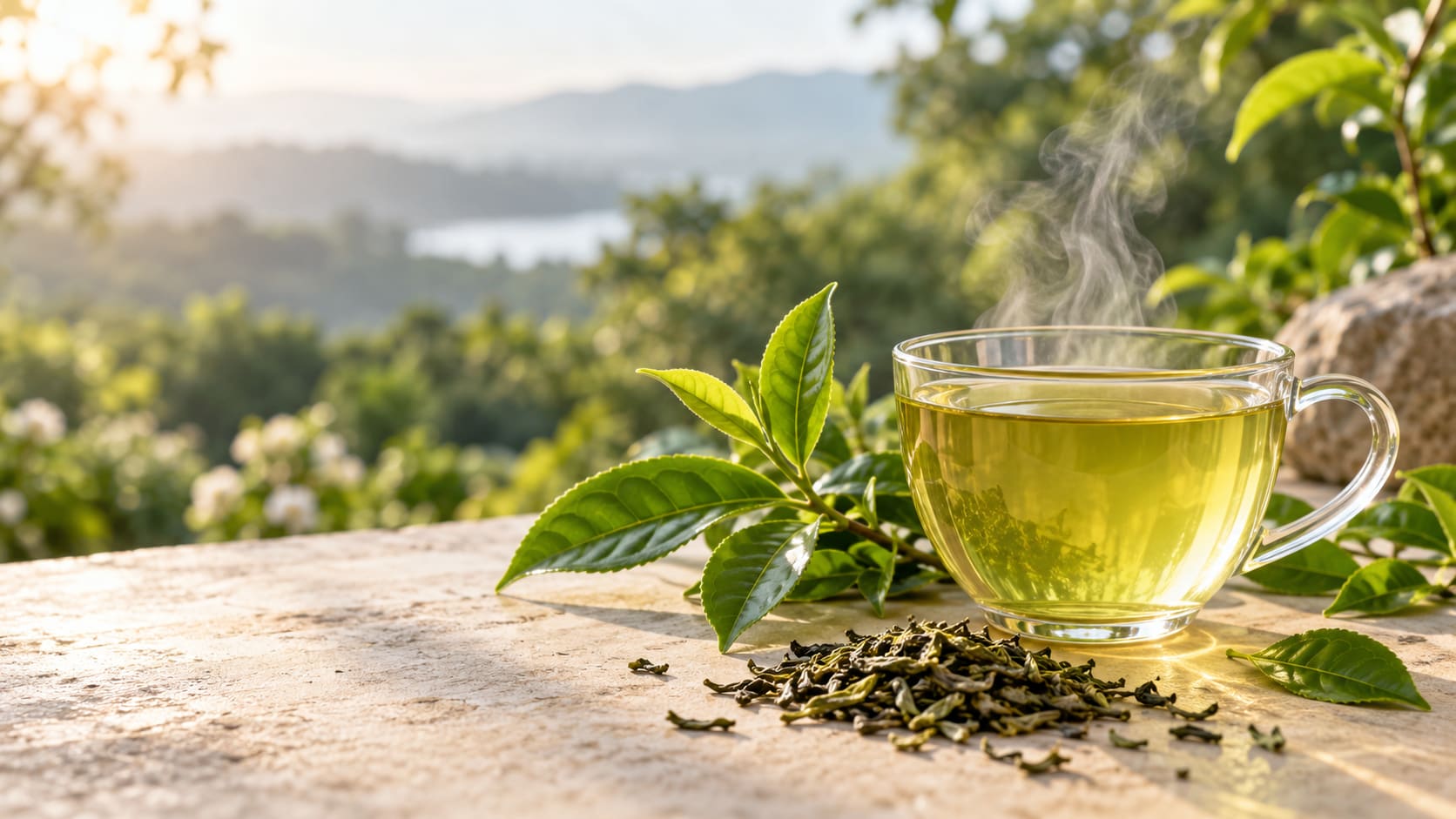
The ratio matters—approximately. A typical cup of green tea has roughly 20–50mg of caffeine and somewhere around 8–30mg of L-theanine, depending on leaf, dose and steep. Matcha and gyokuro — both shade-grown — contain more L-theanine per gram of leaf, and because matcha is consumed as whole powder you get all of it. Whether that is why a bowl of matcha feels calmer than an espresso is a reasonable hypothesis rather than an established fact.
Approximate caffeine per serving (all figures are typical ranges; actual content depends on leaf, quantity, water temperature and steeping time):
• Brewed coffee (240ml): roughly 95–200mg
• Black tea (240ml, 2–3g leaf, 3–5 min): roughly 40–70mg
• Matcha (2g powder whisked in 60–80ml water): roughly 60–70mg; a 4g bowl, about double
• Oolong (240ml): roughly 30–50mg
• Green tea (240ml): roughly 25–45mg
• White tea (240ml): roughly 25–55mg
• Decaffeinated tea (240ml): roughly 2–10mg
The practical advice. There is no universal cut-off time; caffeine's effect on sleep depends on dose, timing and your own sensitivity, so if sleep suffers, move your last caffeinated cup earlier and see what changes (our sleep article covers the evidence). If you enjoy the quieter feel of shade-grown greens on a focused day and a black tea or roasted oolong for a clearer wake-up, that's a fine way to choose—just treat it as personal preference rather than pharmacology.
The supplement note. A whole industry of nootropic supplements has been built on the caffeine-plus-L-theanine combination — usually synthetic L-theanine capsules of 100–250mg with caffeine alongside. The trials behind them used those doses; a bowl of matcha delivers a fraction of that L-theanine, so a tin of matcha is not a substitute for a supplement regimen, and we don't claim it is. What tea offers instead is a modest, pleasant dose in a form people in Kyoto have enjoyed for centuries.
Follow The Tea List