Pairing Tea with Food: The Ultimate Guide for Beginners
What grows together, goes together — but the best pairings often surprise. A working framework of suggestions for matching tea to food, to test against your own palate.
Sameera
· 7 min read
Wine has spent two centuries codifying food pairings. Tea, somehow, hasn't — even though it pairs at least as well, with at least as much variety. Here's a working framework for matching tea to food, drawn from sommelier practice and adapted for the leaf.
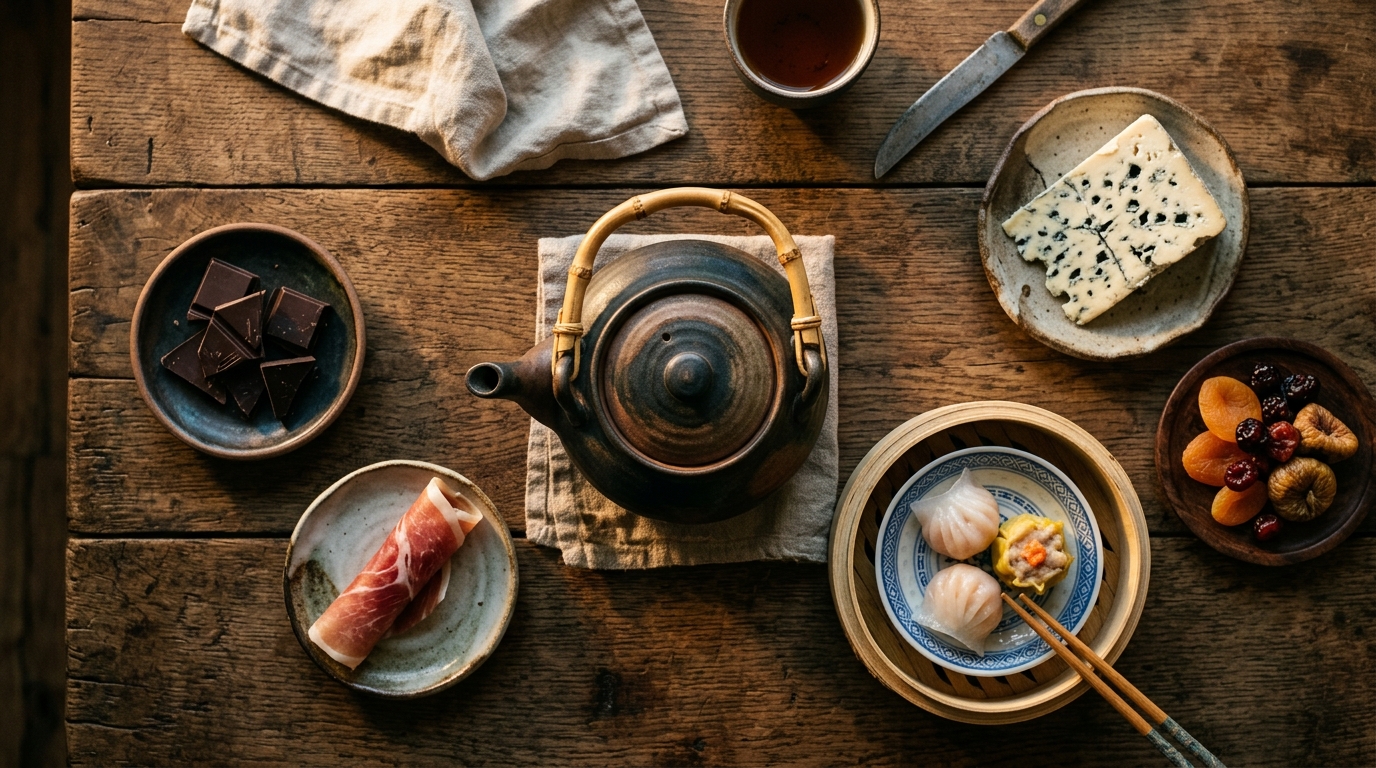
Match weight to weight. Delicate, light-bodied teas (white, sencha, light oolong) pair with delicate food (fresh fish, salads, lemon-and-herb chicken). Full-bodied teas (Assam, roasted oolong, shou pu-erh) pair with full-bodied food (slow-braised meats, dark chocolate, aged cheeses). A heavy meal under-served by a delicate tea will simply overwhelm it; the reverse leaves the tea wasted.
Match origin to origin. Japanese cooking and Japanese tea — sushi with sencha, soba with houjicha — tend to work, because the cuisine and the tea evolved alongside each other. The same is true of Chinese dim sum with light oolongs, Indian thalis with Assam, English biscuits with Ceylon. What grows together, goes together is a useful rule of thumb.
Use tea to cut, balance, or echo. A bright, astringent black tea (Ceylon, Darjeeling) cuts through fat the way a good Champagne does — try it with cured ham or a buttery croissant. A roasted oolong echoes dark, caramelised flavours — pair it with a flourless chocolate cake. A green tea balances salty, oily food — sushi being the obvious example, but it works equally well with fried snacks, miso, and good cheese.
Surprising pairings to try.
• Smoked Lapsang Souchong with smoked salmon
• Earl Grey with lemon shortbread
• White peony with goat cheese
• Houjicha with dark chocolate ice cream
• Aged sheng pu-erh with blue cheese — yes, really; the funk meets the funk and they get along
• Tieguanyin with seared scallops
• Assam with masala dosa
Like wine, the only reliable rule is to taste together. Brew the tea you're considering, take a bite of the food, take a sip of the tea, and pay attention to whether they fight or sing. After a dozen experiments, you'll have a set of pairings that are entirely your own.
Follow The Tea List