The World's Oldest Tea Tree — Still Being Harvested Today
In a remote Yunnan forest stands a tea tree estimated at 3,200 years old. It's still leafing each spring. People are still climbing it.
Sameera
· 6 min read
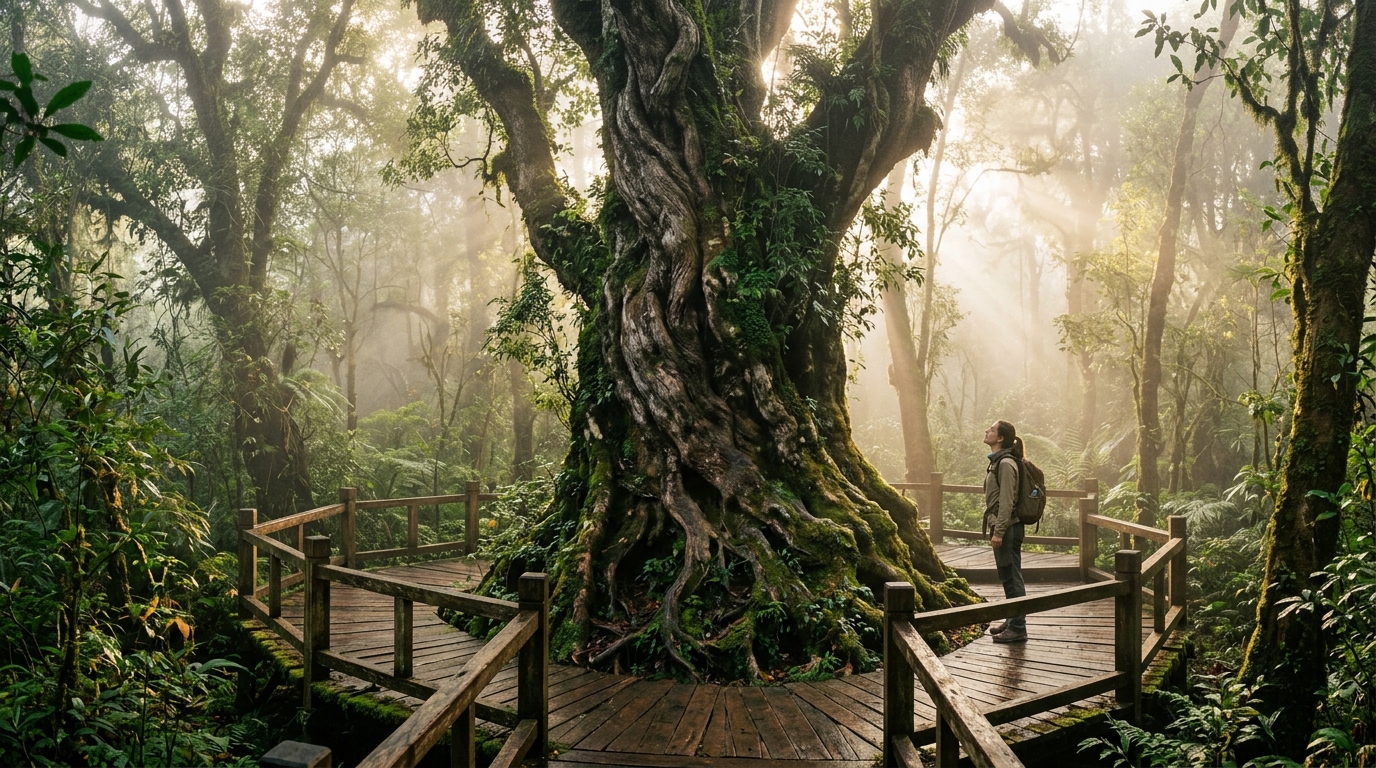
Tea bushes, on a commercial estate, are kept short — pruned to waist height, replaced every 30–50 years. But in the wild forests of southwestern Yunnan, Camellia sinensis trees grow tall, gnarled, and extraordinarily old. The most famous of them all stands in Lincang Prefecture, on a hillside known to local Dai villagers as Jinxiu. It is estimated at 3,200 years old. Locals call it the King of Tea Trees.
The dating. The 3,200-year figure is contested — radiocarbon dating of tea trees is genuinely difficult — but Chinese forestry researchers have proposed estimates between roughly 2,700 and 3,200 years for the Jinxiu King. Even at the conservative end, that places germination in the early Zhou period, centuries after the late Shang and its oracle-bone inscriptions.
The tree. It stands roughly 11 metres tall, with a trunk over a metre in diameter at the base. Several large branches have been propped with wooden supports to prevent them from breaking under their own weight. A wooden viewing platform has been built around the base, allowing visitors to see (but not touch) the trunk.
Still being harvested. A small quantity of leaves are still picked each spring — usually a few hundred grams — by a designated team using bamboo ladders. The leaves are processed into a small batch of pu-erh and either auctioned for charity or kept as a national heritage product. A 25-gram piece of certified King-tree pu-erh reportedly sold at auction in 2014 for over US$40,000.
Other ancients. The Jinxiu tree is the most famous, but not the only ancient. Yunnan has hundreds of trees over 1,000 years old, several over 2,000. The Bada wild tree (Xishuangbanna), estimated at around 1,700 years; the Bingdao Lao Zhai (Lincang) estimated at around 1,400 years; the Jingmai mountain forest, where over a million ancient tea trees—mostly 100 to 300 years old, with some older—are still in active commercial harvest.
Why it matters. These trees are part of the genetic origin of cultivated tea worldwide. They are also among the oldest living, productively used cultivated plants on the planet. A pu-erh made from leaves picked off a 1,000-year-old wild tree represents a continuity of human-plant relationship almost no other agricultural product can match.
Follow The Tea List