The Silk Road of Tea: Routes That Shaped the Modern Cup
Tea travelled out of China by mule to Tibet, by caravan to Russia and by ship to Europe—different routes, different centuries, different evidence. A corrected tour of the trade routes that shaped the modern cup.
Sameera
· 6 min read
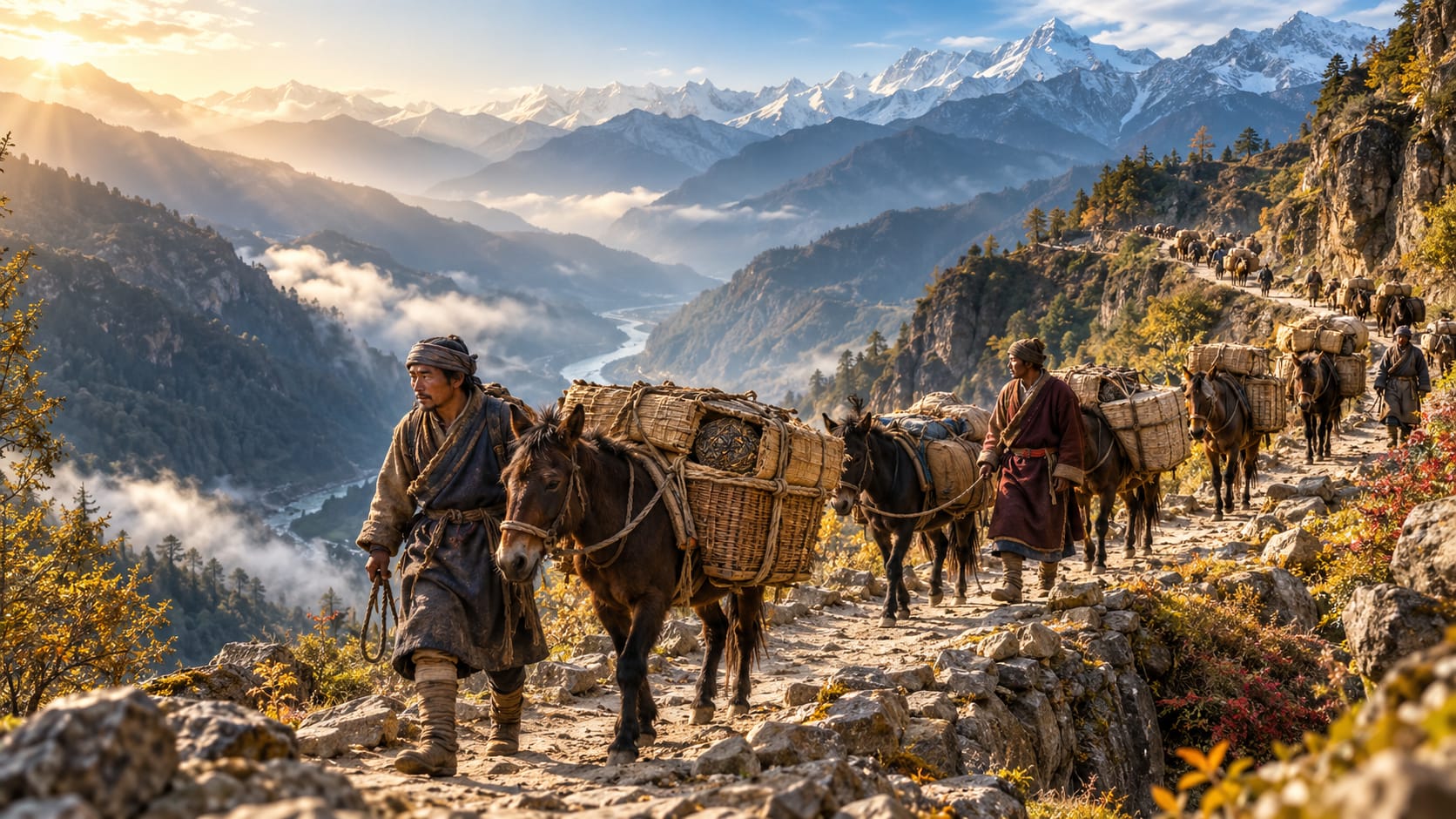
A compressed brick of tea, wrapped in bamboo leaf, once changed hands for horses on the frontiers of the Chinese empire. In the centuries before refrigerated shipping and vacuum-sealed pouches, tea moved across Asia not only as a drink but as a tribute good, a frontier trade commodity and, in some places and periods, a medium of exchange. The story we trace here is really several stories—different routes, different centuries, different kinds of evidence—and it pays to keep them apart.
Editor's note (October 2026): an earlier version of this article compressed those networks into one continuous supply-chain narrative and included logistical details—caravan sizes, journey times, grading practices and storage methods—that we could not trace to historical scholarship. They have been removed. Where we describe something below as tradition or likelihood rather than record, that is deliberate.
Yunnan: Where Tea Grows Wild
The tea plant's story begins in the mountainous country where south-western China meets Myanmar, Laos and north-eastern India. Here, large-leaf Camellia sinensis var. assamica grows as a forest tree, and the Bulang, Dai, Hani and other peoples of Yunnan tended tea gardens long before the plant became an imperial commodity. The age of the oldest cultivated trees is a matter of local tradition more than measurement, and claims of "thousand-year" trees should be read in that spirit.
Yunnan's geography shaped its tea. Moving leaf out of remote highlands across weeks of mule tracks favoured tea that could be compressed, carried and stored—steamed and pressed into cakes and bricks rather than sold loose. Compression was a practical answer to transport, and it is the ancestor of the pu-erh cakes sold today. The now-familiar 357-gram cake, seven to a tong, is a modern convention of the twentieth-century trade; we have no source that projects that exact weight back through earlier centuries, so we don't.
The Tea-Horse Road
The best-documented early tea trade out of Yunnan and Sichuan was not westward along the Silk Road but into Tibet and the Himalaya, along the mule routes known collectively as the Tea-Horse Road (Chamadao). From the Tang and Song dynasties onward, Chinese states exchanged tea for Tibetan horses, and the trade was regulated, taxed and at times run as a state monopoly. Compressed tea became a staple of Tibetan life—churned with butter and salt—and in parts of the Tibetan world it served as a store of value and a means of payment where coin was scarce. That tea could function as a kind of money on this frontier is reasonably well attested; precise, standardised "currency grades" with fixed exchange rates against silver or land are not, and we no longer describe them.
Central Asia and the Silk Road Networks
The overland routes that historians group as the Silk Road—through the Hexi corridor, around the Taklamakan and across Central Asia—carried many goods over many centuries, and tea was among them, especially in the later medieval and early modern periods. Chang'an (modern Xi'an) was a great Tang-era capital and trading city, but we have found no scholarship describing it as a tea "sorting hub" that graded and aged Yunnan cakes for export, and the detailed account that once appeared here has been withdrawn. What can be said is that compressed tea travelled west with other goods, and that steppe and Central Asian peoples developed their own tea habits—often with milk, salt or butter—as a result.
Russia by Caravan
Tea's arrival in Russia is usually dated to the 1630s, when it reached the Tsar's court as a gift from Mongol rulers; regular caravan trade developed in the following century after the Treaty of Kyakhta (1727) formalised Sino-Russian frontier commerce. The tea that reached Russia overland was mostly brick and compressed black tea, and it travelled for many months by cart and camel across Siberia. Russia's enduring taste for strong, dark tea taken sweet is often attributed to this trade. The popular idea that caravan tea picked up a smoky character from campfires along the way is a tradition behind blends called "Russian Caravan"; it is not something the historical record confirms.
Persia and the Middle East
Tea became part of Persian life relatively late—it spread widely in Iran during the nineteenth century, displacing coffee—although tea was known in the region earlier through trade with Central Asia. Persian tea culture developed its own forms: strong tea from a samovar, served in small glasses, taken with sugar. An earlier version of this article credited Persian merchants with shaping tea's flavour through clay-vessel storage and with originating the earthy character of aged pu-erh. There is no evidence for that, and it is not how aged tea works: the darkening and mellowing of compressed tea comes from slow chemical and microbial change during storage in suitable warmth and humidity, wherever that storage happens.
Europe by Sea
Europe's tea came by water, not caravan. Portuguese and then Dutch traders brought tea from Chinese coastal ports in the early seventeenth century; the Dutch East India Company's first recorded shipments date to around 1610, and tea reached England by the 1650s. The British East India Company later dominated the trade, importing green and then increasingly black teas from Canton. Comparisons between the overland and maritime routes as competing "supply chains" are a modern framing—useful as a metaphor, not a description of how seventeenth-century merchants thought.
What It Means for Your Cup
For modern Australian and New Zealand tea drinkers, these histories are in the cupboard. A pressed pu-erh cake carries Yunnan's compression tradition. A "Russian Caravan" blend carries a name and a story, if not a verified smoke. A Darjeeling or a Chinese green reflects the maritime trade that made leaf tea Europe's habit. Speciality tea today still works through chains of knowledge—growers, processors, importers, blenders—rather than any single point of production, and that much the old routes genuinely share with the new.
Next time you unwrap a compressed cake on a cold July evening, consider what is documented and what is lore. The compression was for transport. The depth comes from time and storage. And the romance of the caravan is real enough as romance—it just shouldn't be mistaken for a shipping manifest.
Follow The Tea List