The Rise of Specialty Tea in Japan: From Uji to Shizuoka
Two regions, hundreds of years apart in tradition, now define Japanese specialty tea. Here's what makes Uji and Shizuoka utterly distinct—and why Australian tea drinkers are finally paying attention.
Sameera
· 9 min read
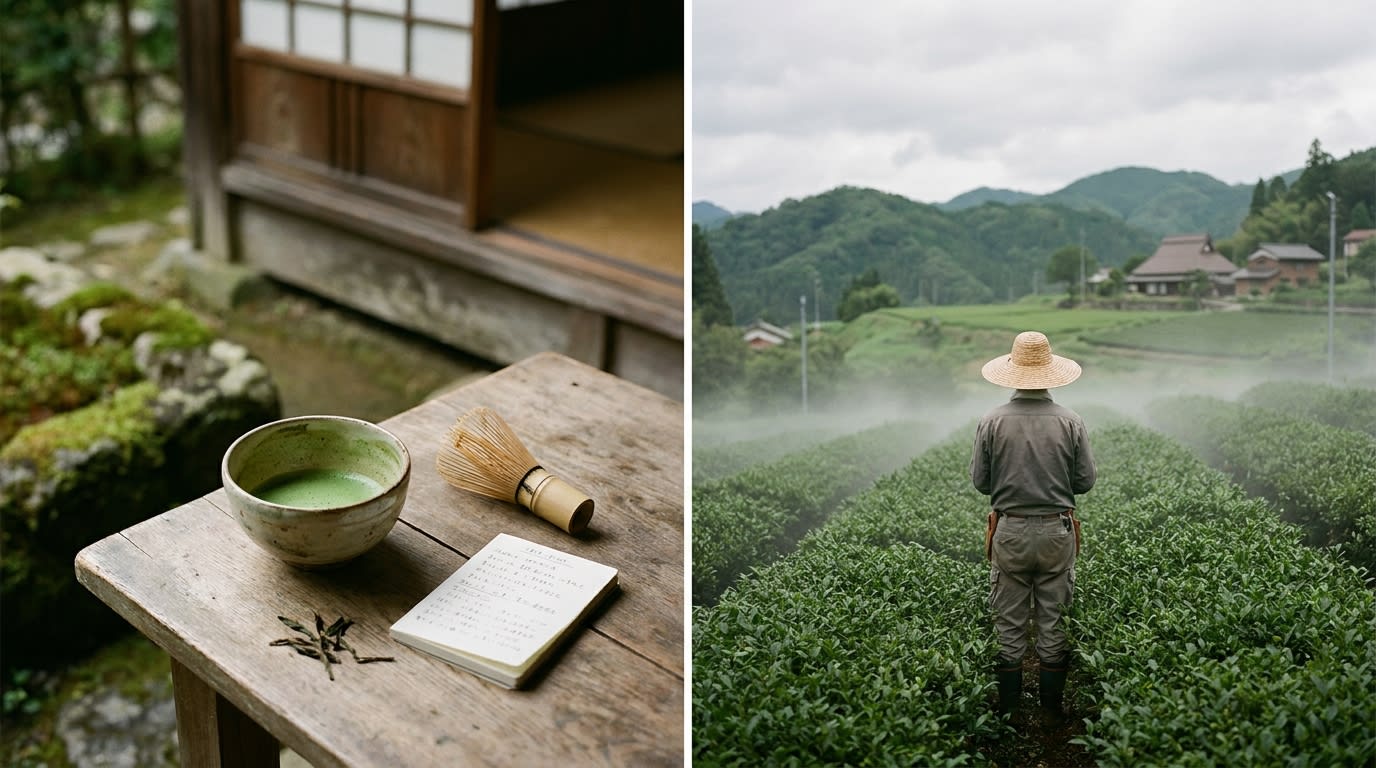
In late April, when Melbourne's autumn chill starts to bite and Sydney's jacarandas are long past bloom, something remarkable is happening about 8,000 kilometres northwest. In the foothills of Kyoto and across the volcanic slopes of Mount Fuji, tens of thousands of hands begin the first flush harvest of Japanese specialty tea—a season so brief and so prized that some producers will pick for only ten days before the character of the leaf changes entirely.
Two regions, one plant, infinite nuance
When Australians think of Japanese tea, they often picture a uniform green powder or a grassy sencha bought from T2 on a Saturday afternoon. But Japanese specialty tea—the kind now appearing at Australian independent retailers—tells a far more granular story. It's a story of two regions separated by roughly 300 kilometres and centuries of philosophy: Uji, the heartland of matcha and Japan's aristocratic tea culture, and Shizuoka, the pragmatic powerhouse that has long been Japan's largest tea-producing prefecture (Japanese agricultural statistics have put it at roughly a third or more of national crude-tea output in recent years, with Kagoshima close behind) and that pioneered mechanised cultivation without sacrificing quality.
Both grow Camellia sinensis var. sinensis, the same species that gives us Darjeeling and Longjing, but the similarities end there. Uji's specialty lies in shade-grown teas—gyokuro and tencha (the leaf that becomes matcha)—where weeks under black fabric force the plant to produce more chlorophyll and L-theanine, resulting in that unmistakable sweetness and umami depth. Shizuoka, by contrast, thrives on sun and altitude, producing bright, refreshing sencha and the occasional fukamushi (deep-steamed) style that drinks almost like a broth.
Yabukita: the cultivar that changed everything
If you've drunk Japanese tea in Australia, you've almost certainly tasted Yabukita. Selected in 1908 by Shizuoka tea researcher Hikosaburo Sugiyama and officially registered in 1953, this single cultivar dominates Japanese tea farming: Japanese agricultural surveys have put Yabukita at roughly 70–75 per cent of the nation's planted tea area. (That is a measure of acreage, not of finished tea; the two are often conflated.) It's the Chardonnay of Japanese tea: reliable, adaptable, frost-resistant, and capable of producing a clean, balanced sencha with vegetal sweetness and minimal astringency.
Shizuoka is Yabukita's kingdom. The region's volcanic soil—rich in minerals from Mount Fuji's eruptions—and its temperate maritime climate create ideal conditions for this cultivar's slightly later bud break, usually in mid-to-late April. When processed as a standard sencha, Yabukita offers the grassy, fresh-cut notes that Australian palates often associate with "green tea." When deep-steamed into fukamushi-cha, the leaf particles break down further, producing a cloudy, jade-coloured liquor with intensified flavour and body.
You'll find Yabukita-dominant senchas at most Australian specialty retailers; product pages increasingly state the prefecture and sometimes the cultivar, which is the detail to look for. (Earlier versions of this article described specific retailer–farm relationships that we could not verify; they have been removed.)
The outliers: Asatsuyu and Goko
But the story gets more interesting when you step outside Yabukita's shadow. Enter Asatsuyu, a cultivar sometimes called "natural gyokuro" for its inherent sweetness and low astringency—even when grown in full sun. Registered in 1953, Asatsuyu is far less common—a small fraction of Japan's planted area—and notoriously difficult to work with. Its leaves are delicate, its harvest window narrow, and its susceptibility to frost makes it a gamble in all but the most sheltered microclimates.
Yet when it works, Asatsuyu is extraordinary. The liquor is thick, almost syrupy, with pronounced umami and none of the sharp vegetal bite that can overwhelm lighter green teas. Uji producers prize it for gyokuro production, where its natural sweetness is amplified by 20–25 days of shade cultivation before the first flush. In Shizuoka, a handful of small farms grow Asatsuyu as a sencha, producing a tea that drinks like something between a Chinese Anji Bai Cha and a light Japanese gyokuro—grassy, but round and mouth-filling.
Goko, by contrast, is Uji's secret weapon for matcha. A Kyoto selection with roots in Uji's native seed-grown tea, Goko is a shade-loving cultivar with broad, tender leaves that produce a particularly fine, vibrant green powder. Its flavour profile leans sweeter and less astringent than Yabukita-based matcha, with a creamy body that works beautifully in usucha (thin tea) preparations. Goko is rare outside Kyoto Prefecture and almost never exported as a loose-leaf tea, which makes it a connoisseur's footnote—but it's worth knowing if you're comparing Australian matcha labels, many of which now specify the cultivar blend.
Some Uji matcha labels specify cultivars like Goko as part of multi-cultivar blends designed for traditional whisking rather than lattes.
Harvest, processing, and the 88th night
Japanese tea follows a precise seasonal rhythm, and timing is everything. The first flush, or ichibancha, begins in mid-April in warmer Shizuoka plains and extends into early May in cooler Uji highlands. There's even a folk tradition tied to this: hachijū-hachiya, the 88th night after the start of spring (around 1–2 May), is considered the ideal day to drink new-season sencha for good health and longevity. Whether or not you buy the folklore, the science suggests first flush leaves are typically higher in amino acids and aromatic compounds, while catechins tend to be lower than in later harvests.
After plucking, the clock starts. Japanese tea is defined by its "kill-green" method: steaming the leaf within hours of harvest to halt oxidation and lock in that vivid green colour. Uji producers typically use a light steam (20–40 seconds) to preserve the leaf's shape and clarity, essential for high-grade gyokuro. Shizuoka, especially in the Kakegawa region, pioneered fukamushi steaming (60–120 seconds), which breaks down cell walls and creates that distinctive cloudy infusion.
From there, the leaf is dried, rolled, and sorted. The finest leaves—uniform, unbroken, deeply green—are reserved for premium grades. The smaller particles and stems become konacha (powder tea) or kukicha (twig tea), both of which are increasingly popular in Australia for their approachability and lower price point. Madame Flavour in Melbourne offers a lovely organic kukicha that's particularly gentle for evening drinking, with lower caffeine than typical sencha and a toasted, slightly sweet character.
Getting Japanese specialty tea to Australia
Here's the logistical reality: fresh Japanese tea is seasonal, and shipping takes time. First-flush sencha picked from late April generally reaches Australian specialist retailers from late May into June—air-freighted shincha a little earlier, sea-freighted stock later. (Our buying guide uses the same timing.) This is why many specialty shops pre-sell their ichibancha allocations or release them in limited batches.
Specialist importers tend to air-freight their highest-grade gyokuro and shincha and sell it in limited allocations at a premium; larger retailers buy through exporters and rotate stock through the year. Ask any retailer where and when a specific tea was harvested rather than assuming an origin from the brand.
If you're serious about freshness, ask your retailer when the tea was harvested and when it arrived in Australia. Japanese green tea is at its best in the months after harvest. Store it protected from moisture, heat, light and odours—an airtight tin in a cool pantry is the default. If you refrigerate an unopened, well-sealed pack to extend its life, let the sealed container come fully to room temperature before opening so condensation doesn't form on the leaf, and follow the producer's own storage directions where given. (This is the same rule our storage guide uses.)
Why it matters here
Australian tea drinkers are developing a taste for specificity. We've moved from "green tea" as a monolith to asking about origin, cultivar, and harvest date—the same questions we've been asking about coffee for a decade. Japanese specialty tea rewards that curiosity in ways that few other tea-producing countries can match. The transparency is there: most Japanese farms are small (under five hectares), family-run, and increasingly willing to share detailed production notes. The quality is verifiable, the flavour is distinct, and the cultural lineage runs deep.
Uji and Shizuoka represent two poles of that tradition—one steeped in ceremony and shade, the other in innovation and sun—but both are producing some of the most compelling green teas available to Australian drinkers right now. Whether it's a Yabukita sencha that reminds you of fresh-cut grass on a winter morning, or a rare Asatsuyu gyokuro that drinks like liquid silk, this is tea that asks you to slow down and pay attention.
And in a country where specialty coffee has taught us to care about origin and process, it's a question worth answering with a cup in hand.
Follow The Tea List