Tea and Sleep: What Actually Works (and What Doesn't)
From chamomile's apigenin to caffeine's six-hour shadow, we separate the science from the folklore in Australia's favourite bedtime ritual.
Sameera
· 9 min read
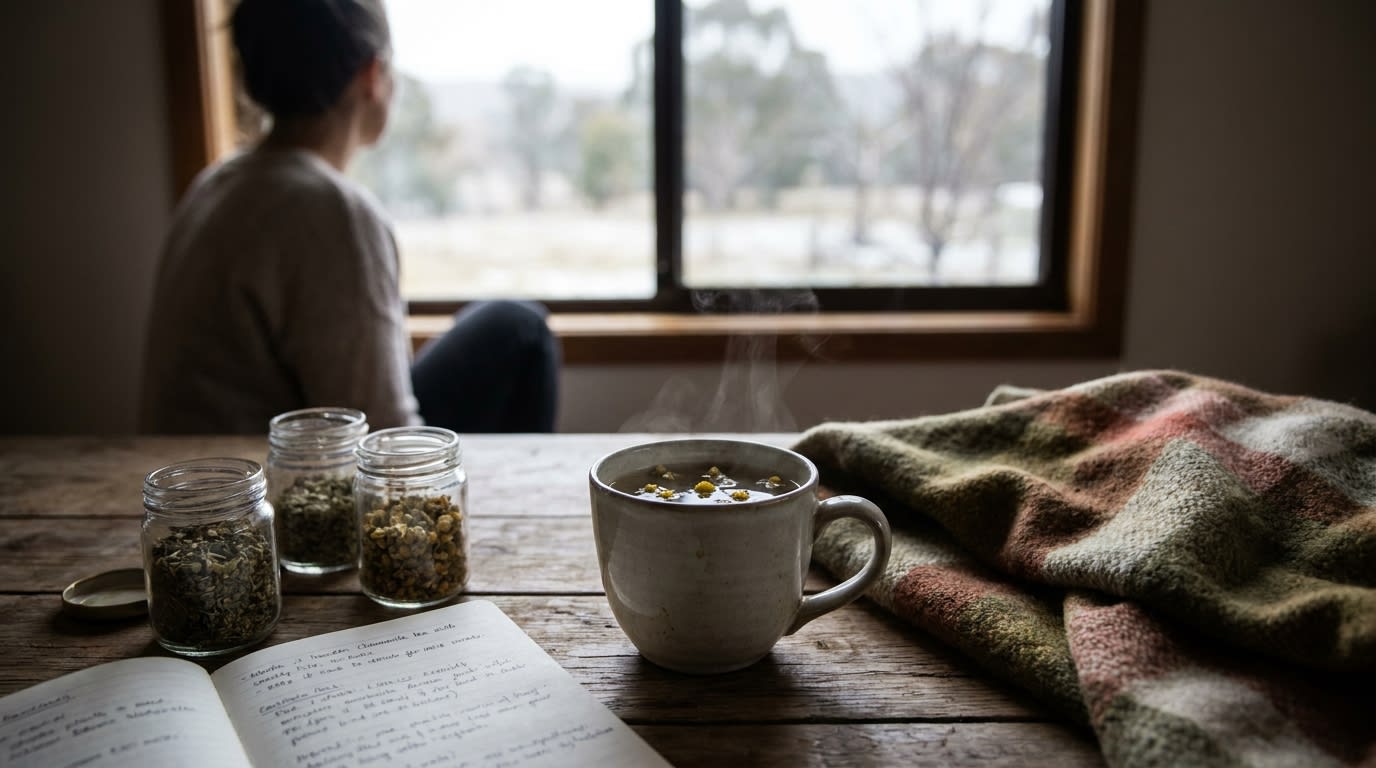
At 9pm on a June evening in Melbourne, the temperature outside hovers at 7°C. Inside, the kettle clicks off. You're reaching for something that promises sleep—a chamomile sachet, perhaps, or a proprietary blend labelled Sleep Well or Tranquil Night. But does any of it actually work? The answer is more interesting than the marketing suggests.
The Apigenin Question: What Chamomile Actually Does
Chamomile (Matricaria chamomilla) contains apigenin, a flavonoid that binds to benzodiazepine receptor sites in laboratory studies—one proposed mechanism for its reputation as a calming herb. The clinical evidence is thinner than the folklore. A small 2011 randomised, double-blind, placebo-controlled trial (Zick and colleagues, 34 adults with chronic insomnia, 270mg of chamomile extract twice daily for 28 days) found no statistically significant benefit over placebo on the measured sleep-diary outcomes, including sleep quality, sleep efficiency and total sleep time. The study tested a standardised extract, so its results do not establish an effective dose of brewed chamomile tea either way, and nobody has shown how many grams of flower would equal an extract capsule. The honest summary, which matches the US National Center for Complementary and Integrative Health's assessment, is that evidence for chamomile in insomnia remains inconclusive. That doesn't make a cup of chamomile pointless—ritual matters, warmth matters—but treat it as a pleasant bedtime drink rather than a treatment. If you enjoy the flavour, loose German chamomile from a specialist Australian tea merchant brewed as a generous 3–4 gram serving tastes fuller than a sachet; that's a flavour preference, not a dose.
Valerian: The Herb That Smells Like Socks
Valerian (Valeriana officinalis) has been used as a sedative since ancient Greece, and its reputation persists in the supplement aisle of every Chemist Warehouse from Cairns to Hobart. The smell is famously unpleasant—earthy, almost fetid. Laboratory work suggests valerian constituents interact with GABA (gamma-aminobutyric acid) signalling, but systematic reviews of human trials have found inconsistent results and mixed evidence quality, and NCCIH describes the evidence for valerian in insomnia as inconclusive. Most trials have used extracts rather than brewed tea, so the conclusions do not transfer neatly to a teapot, and consistent use has not been shown to make it work. If you like it anyway, blends that pair valerian with passionflower and lemon balm are easier to drink than valerian alone. Prepare herbal infusions as the packaging directs—normally freshly boiled water and the stated infusion time. Accept the smell. Add honey if you must.
Passionflower: The Anxiolytic You've Overlooked
Passionflower (Passiflora incarnata) is native to North America and is cultivated in Australia; various Passiflora species occur in NSW, but P. incarnata is not widely naturalised along the coast. Unlike chamomile or valerian, passionflower's primary benefit isn't sedation but anxiolysis: it reduces the mental chatter that keeps you awake. A small 2011 study in Phytotherapy Research found that participants who drank passionflower tea for seven days reported significantly improved sleep quality compared to a placebo group, with the effect attributed to reduced anxiety rather than direct sedation. The active compounds—flavonoids and maltol—modulate GABA receptors, similar to valerian but through different pathways. If your sleep issue is a racing mind rather than physical restlessness, passionflower is worth trying. Tielka, the Australian native tea company, sources passionflower locally and blends it with lemon myrtle in their Relax infusion. Steep 2 grams in 200ml at 95°C for 8–10 minutes. Drink it an hour before bed, not five minutes before.
Caffeine's Six-Hour Shadow: The Timing Problem
Caffeine can disturb sleep, but the effect depends on dose, timing and individual sensitivity—there is no universal clock time. Caffeine's half-life is often quoted at roughly five to six hours in adults, though it varies widely between people, so some of a late-afternoon cup is still circulating at bedtime. The study most often cited here is Drake and colleagues' 2013 experiment in the Journal of Clinical Sleep Medicine, which found that 400mg of caffeine taken six hours before bed measurably disrupted sleep. That is a large dose—substantially more than the roughly 40–70mg in a typical 250ml cup of strongly brewed black tea—so the study does not show that every afternoon cup wrecks sleep architecture. Later dose-and-timing trials point the same way: higher doses and later timing matter more than any single cut-off. If your sleep is poor, experiment with pulling your last caffeinated cup earlier and see what changes for you, rather than adopting someone else's 2pm rule. In winter, when the Melbourne sun sets at 5:15pm and the evening stretches long, that's harder than it sounds. The ritual persists even when the chemistry works against you.
What to Drink on a Winter Australian Evening
So what fills the gap between dinner and bed? Nothing in a teapot is a proven sleep treatment, so choose by flavour and by what you find calming. If you like chamomile, a generous infusion of 3–4 grams of loose flower, brewed with freshly boiled water for the time on the packet (commonly 5–10 minutes), tastes rounder and more apple-like than a quick sachet dunk. Add a teaspoon of Australian honey—Tasmanian leatherwood has a distinctive aroma but no proven sedative properties. If a racing mind is the issue, passionflower or lemon balm (Melissa officinalis) are pleasant alternatives; lemon balm grows easily in Australian gardens and contains rosmarinic acid and other compounds that may influence stress responses, though the human evidence is preliminary. Brew 2–3 grams of fresh leaves (or 1 gram dried) in 200ml of freshly boiled water for 6–8 minutes, or as the packaging directs. Bird & Blend's New Zealand range includes a Snooze blend that combines chamomile, lavender, and rooibos—rooibos being naturally caffeine-free and rich in aspalathin, an antioxidant that may reduce stress hormone levels. It's not clinically proven to improve sleep, but it won't worsen it, and it tastes warm and faintly sweet.
The Ritual vs. The Active Ingredient
Here's where the science gets muddy and interesting. A 2015 meta-analysis in PLOS ONE examined the placebo effect in insomnia treatment and found effect sizes comparable to some pharmaceutical interventions. The act of preparing tea—boiling water, measuring leaves, waiting, holding a warm cup—signals to your autonomic nervous system that the day is ending. This is not trivial. In Canberra's winter, where frost forms on lawns by 7am and the air inside is dry from gas heating, the humidity from a steaming cup changes the sensory environment in your favour. You're not just drinking apigenin or valerenic acid; you're enacting a shutdown protocol. The gongfu tea ceremony, though traditionally associated with oolong and pu-erh, has been adapted by some Australian tea practitioners as an evening mindfulness practice using caffeine-free tisanes. The repetition—rinse, steep, pour, sip—creates a liminal space between wakefulness and sleep. Whether the tea contains pharmacologically active compounds becomes almost secondary.
What Doesn't Work: The Marketing Traps
Lavender tea smells beautiful and tastes like soap. Lavender has been studied in three quite different forms—as a tea, as oral medicinal oil preparations, and as an inhaled aroma—and none of them can be assumed equivalent to the others. NCCIH's summary is that some small studies of oral lavender preparations and of aromatherapy have reported effects on anxiety or sleep, but the research is limited and reliable conclusions are not yet possible. So drink lavender tea if you enjoy it; just don't expect a tisane or a pillow spray to deliver a documented treatment. Sleepytime blends that contain fifteen different herbs in trace amounts are unlikely to deliver clinical doses of anything. Check the ingredients list: if chamomile isn't the first or second ingredient by weight, you're paying for marketing. Decaffeinated black or green tea still contains 2–5mg of residual caffeine per cup, which accumulates across multiple servings. And please: drinking Camellia sinensis varietals like white tea or lightly oxidised oolong doesn't bypass caffeine just because they taste delicate. A Silver Needle white tea can contain 30–40mg of caffeine per cup. Oxidation level is not a reliable predictor of caffeine content—that varies more with cultivar, leaf position, and processing.
The Winter Context: Sleep in the Australian Cold
In Australian and New Zealand winters, sleep disruption often has less to do with caffeine and more to do with temperature regulation. The optimal sleep environment is 16–19°C, but many Australian homes—particularly older weatherboard houses in Brisbane or un-insulated Sydney terraces—swing between overheated (from plug-in heaters) and freezing (once the heater's off). A warm tisane before bed raises core body temperature temporarily; the subsequent drop signals to your circadian system that it's time to sleep. This is why hot baths work. The tea itself is a low-tech thermoregulation tool. Pair it with woolly socks and you're optimising for sleep onset. In Auckland, where winter means damp cold and houses are notoriously underheated, the ritual of making tea becomes a way to warm your hands and core before bed. It's not about apigenin—it's about not being cold.
The Honest Answer
Tea for sleep—what works? Less than the packaging claims. The clinical evidence for chamomile and valerian in insomnia remains inconclusive, and passionflower rests on a handful of small studies. What is better supported is unglamorous: keeping late caffeine modest and finding your own cut-off, a consistent wind-down ritual as an autonomic signal, and warmth as a circadian cue. Everything else—the lavender garnish, the twelve-herb blend, the packaging that promises deep rest—is atmospheric. Which is fine, actually. Atmosphere counts. If you're reaching for tea because your sleep is genuinely and persistently disrupted, talk to a GP; herbal tea is a pleasant ritual, not a treatment plan. And if you simply want a better cup of chamomile, brew it generously, give it time, and enjoy it for what it is.
Somewhere in Hobart tonight, someone is steeping chamomile and watching frost form on the window, waiting for sleep to arrive like a guest who's always slightly late.
Follow The Tea List